A live course in AI-assisted engineering.

Learn how to define work before implementation, verify generated changes, keep delegated work reviewable and recover when an approach fails.

Delivery
Live online
Length
Four 40-minute sessions
Experience
Two months to two decades
Method
Repository exercises with tutor review
Languages
Python, TypeScript, C# and Rust

Two months or two decades into engineering

You should be comfortable reading, changing and testing code. Newer engineers get a method to follow. Experienced engineers examine decisions they may otherwise make by instinct. You do not need to use a particular model or editor.

What this course is not

  • A general introduction to AI
  • A prompt-writing workshop
  • A product demonstration
  • A claim that one tool can replace engineering review

Fast output is not the same as faster delivery

Small, well-defined tasks with a quick check are where coding assistants can be most useful. Long, ambiguous repository work can hand that gain back through review, rework and regression cleanup.

A controlled experiment found developers completed one defined JavaScript HTTP-server task 55.8% faster with GitHub Copilot.

Nearly right is expensive

METR's early-2025 randomised study found experienced open-source developers took 19% longer with AI tools on real issues in repositories they knew, even though they believed they had been faster.

Lee calls the lost time review churn and expansion: plausible changes grow, engineers find regressions and the time saved generating code is spent establishing what is safe to keep.

Read the controlled Copilot study, METR's early-2025 study and METR's 2026 update. The later update says newer tools probably improve results, but selection effects prevented a reliable current estimate.

The work you will do

The examples below come from the current course repositories. They describe the learner task without revealing the facilitator checks.

Session 1

Verification before trust

Treat generated work as untrusted until you have checked it independently.

Exercise
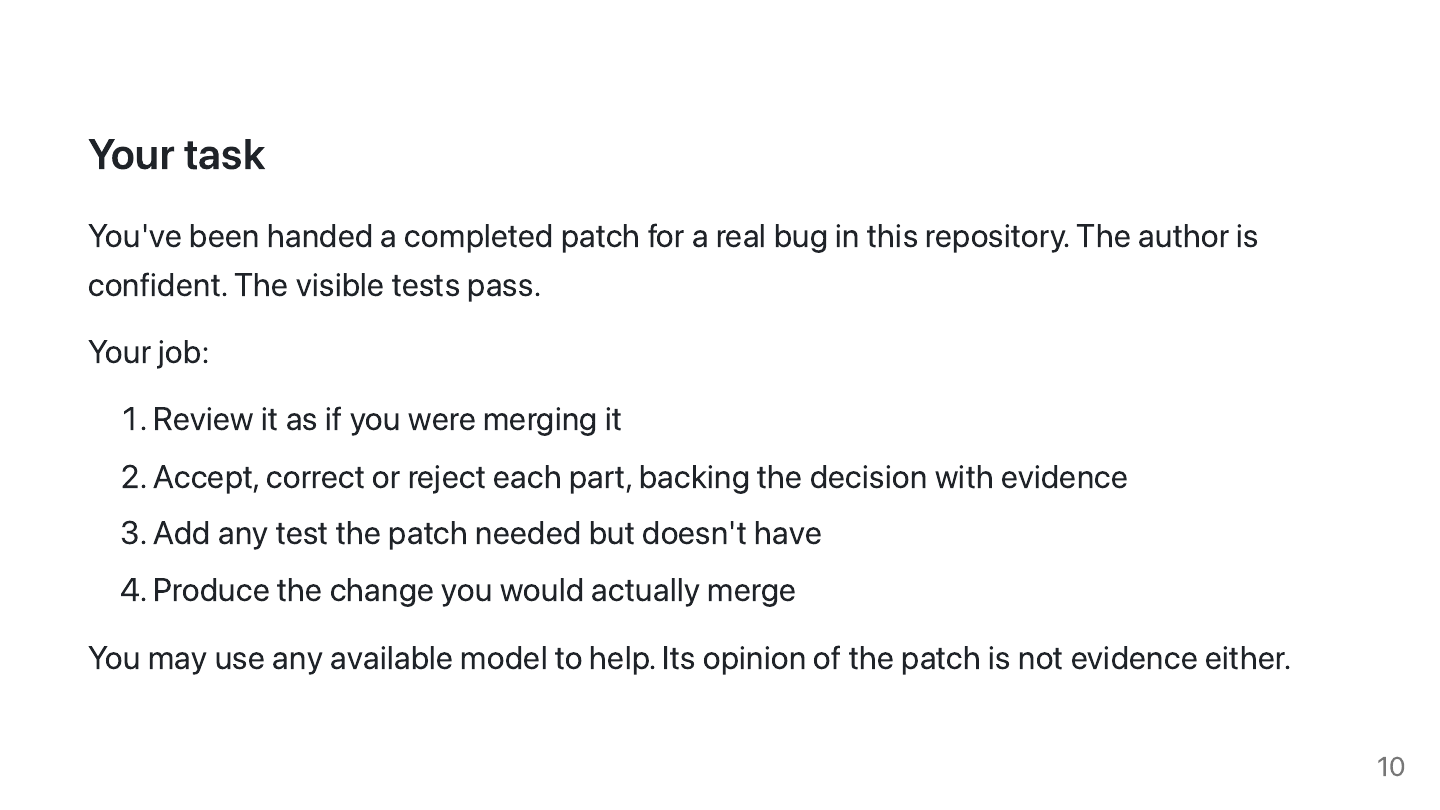
Review a supplied patch for a transcript service. The visible tests pass, but that is not enough to approve the change.
You produce
The code you would merge, a test you added and a short written review.
Session 2

Problem definition

Define ambiguous work before asking a coding tool to implement it.

Exercise
Turn a one-line request for installer profile pictures into testable criteria, constraints, questions and a verification plan.
You produce
An implementation-ready task definition, revised after a repository review.
Session 3

Bounded delegation

Give a coding tool only the work you can still review properly.

Exercise
Add project notes to a repository that contains conflicting conventions, old code and security-sensitive helpers.
You produce
A focused code change, delivered and checked in small steps.
Session 4

Recovery and change control

Change course when the evidence shows that the current approach is wrong.

Exercise
Investigate stale note history where the obvious cache diagnosis may not explain the failure.
You produce
A clean final fix and a record of what you established, ruled out and changed.

Most of the time is spent on the task

  1. 01
    Briefing

    Lee explains the rule and the engineering risk behind it.

  2. 02
    Repository work

    You inspect the task, use your coding assistant and run your own checks.

  3. 03
    Review

    You explain what you accepted, changed or rejected and show the evidence.

  4. 04
    Debrief

    The group compares approaches and identifies what to carry into normal work.

Module 1 task slide describing the supplied patch review
Open the full-size Module 1 task briefing

Python, TypeScript, C# and Rust exercises

The current exercise library spans all four languages. Python covers the complete course; selected modules also have TypeScript, C# and Rust variants. Lee confirms the exercise set before booking.

Each repository includes a task, existing code and visible tests. You keep the final change and written work you produce.

Based on what you can show

Feedback covers the result, the checks you ran, the scope you controlled and how you responded to new evidence.

Model choice, prompt style and token use are not scored. A single session gives limited evidence and is not presented as a certification.

Session privacy

The course is live and unrecorded. You control what you share with Lee and the group.

  • Zoom is not recorded and its automatic AI summary is off.
  • Any optional local capture needs written agreement.
  • You may decline to share your assistant conversation.
  • Team reporting is agreed before a private course begins.

Get the dates when booking opens.

Join the waiting list